I intend on giving my fist impressions of books and final reviews, rather than giving a step by step break down. Makes more sense to me.
Crimson Book of Pirates
Last night I started the Crimson Book of Pirates by Peter Newark. So far, it’s been quite entertaining. Starting off with a general run down of pirate history. He makes some interesting points which he obviously swoops over as they have no major relevance to the topic he is discussing, such as the benefits to Western architecture and culture as influenced by the East during the crusades, but it did make me more aware of the fact that he references no secondary material whatsoever. I greatly dislike reading history books which don’t give proof/reference for the points they are making. I find them more difficult to take seriously. Anyone who has read Noam Chomsky’s work will know that he uses a mass of precise and full references, but every so often he skips a reference and I have always found that irritating (along with his occasionally overly dramatic language, which I feel has no place in “objective” political and historical writing). So much so that I eventually stopped reading his work. Crimson Book of Pirates, as a result, despite its references to rampant pirate homosexuality during long sea voyages, reads more like a child’s book on “Pirateology”, but has so far been an enjoyable read and I’m looking forward to getting into the individual pirate biographies. My short time studying journalism and history has given me ideas about myself and I shouldn’t really allow those aspirations to come between myself and a good book. Mind you the fact that I found it impossible to find any images of the cover of the book anywhere on the Internet may attest to how it could be ignored.
Mind you it isn’t all about history, the Somali coast, a couple taken from their yacht last week and now this: Piracy off the Seychelles
If you’d like to see how common modern-day piracy is have a look at this: Map of Piracy
I Served the King of England

I also began reading I Served the King of England by Bohumil Hrabal, after receiving it as part of a nifty little book swap with a friend. I didn’t get a chance to get into it properly as I had begun falling asleep, but love the lack of paragraph breaks and dialogue punctuation which allows the reader to flow more easily through the book and reads more like stream of conciousness than anything I have read before, including Kerouac. More importantly Hrabal is able to communicate dialogue without its punctuation a lot more clearly than Cormac McCarthy, whose writing I find unnecessarily difficult to follow at times.
Hrabal, a Czech writer, brings me to the celebration of the Velvet Revolution which was also in the news today Celebrating Revolution with Roots in Rumour
Classical Liberalism vs. Anarcho-Capitalism
Nick P. over at Black Sun Gazette has written a very interesting critique Jesus Huerta de Soto’s Classical Liberalism vs. Anarcho-Capitalism. His blog usually makes for interesting reading, as many of his beliefs would reflect my own. I don’t want to group either party’s political leanings, but quite a bit left should suffice. Nick’s article makes good reading as in discussing De Soto’s points he also allows for a criticism of anarcho-capitalism and the many failings of its political theories. However, I personally wouldn’t agree with all of Nick’s points, bearing in mind that my ramblings are not as coherent or well thought throw as his. Though both Nick and De Soto agree in that an end to the nation-state is required, De Soto obviously believing it necessary to allow freer capitalism (mentioning more road tolls as a “good” example of what this would allow), their reasoning for this is obviously very different. De Soto argues that government “infantilizes” population so as to allow them to be ruled over more easily, which may have an element of truth in it. He believes people are too quick to idolise government, but is way off in stating that it is the “most serious and dangerous social disease” affecting the modern world. But if you read Nick’s article you’ll find a better run down of all his points that I could currently give.
My issue with both pieces is that they tend to, like Marxism and most political theory, patronise those which they write about and for whom they believe they are seeking a better word, usually written by a relatively wealthy intellectual who seems somewhat removed from the situation about which they discuss. On top of that over 160 years after The Communist Manifesto was written those class boundaries which Marx talked about are not as clear as before. Capitalism has allowed for a blurring of distinction between the “boss” and “the worker”, but those who support its original tenets can easily fall back on the usual “capitalist” and “worker” labels when it suits them. Nick P. falls into the trap of referring to McDonald’s workers, which has really become a cliché at this point. What is working class anymore? Who is bourgeois? What defines these labels, pay, location, education? Again, political theory falls short of taking human nature into consideration and in attempting to create equality does more to divide. In saying all that De Soto does seem more out of touch with the real world than most commentators I have come across.
Sometimes I wonder if the more basic ideas, based almost purely on positive human nature are the more worthwhile, like this video from NURU International (Vimeo, so can’t embed): Jake’s Story
Mere ramblings on my part again, but for a greater insight have a look at Black Sun Gazette.
How to Use a Multimeter
On a more practical level, having just managed to get one of my bangers through their road worthiness test, I have yet to fix/destroy my other. Lack of money has meant attempting to take this on myself, which doesn’t sound too bad, but after plenty of scraped knuckles and rants verging on tears I realised and accepted that I need to read a bit more before continuing, so yesterday i read up on how to use a multimeter, after a couple of difficult to follow sites, I found this nice and handy PDF which is quite basic, but definitely easier to follow: MULTIMETER GUIDE
Typography, again
Those of you who read yesterday’s Mistakes in Typography Grate the Purists may be interested in the response on Bookninja: On typographic fetishism as mental illness
John Murray, Publishing House: The History
A friend recently mentioned John Murray to me and I confess I had never paid much attention to them, but after looking through their back catalogue found that they have definitely been a strong contender in the field and I fell I really should have given them a little more credit. Interesting article at The Fiction Desk discusses the role of the bookseller publisher after the publication of the house’s history earlier in the year, The Seven Lives of John Murray.

History Doesn’t Always Forget
New York Time’s article about recent prosecutions of Nazi war criminals in Germany
Rwandan Hutu Rebels arrested in Germany
Final Flourish
Takashi Furuya Illustrations

Image taken from the brilliant Retro To Go
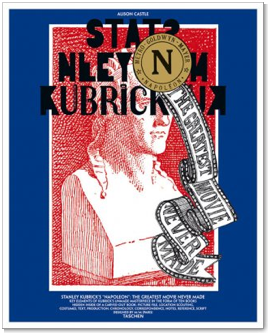
Brainpickings have a nice piece on the book which chronicles Stanley Kubrick’s Napoleon, which he obviously never made, mostly due to finances, it’s clear from the book why: Kubrick”s Napoleon, The Greatest Film Never Made